

Why you should never bend fiber optic cables — and what it does to your Ethernet network
Think of a garden hose: kink it too tightly and the water stops flowing. Fiber optic cables work on a very similar principle — except here, the “water” is light, and the consequences reach all the way up to your network layer. When a fiber cable is bent beyond its minimum bend radius, we enter the territory of bending losses. There are two distinct failure modes you need to understand:
Macrobending
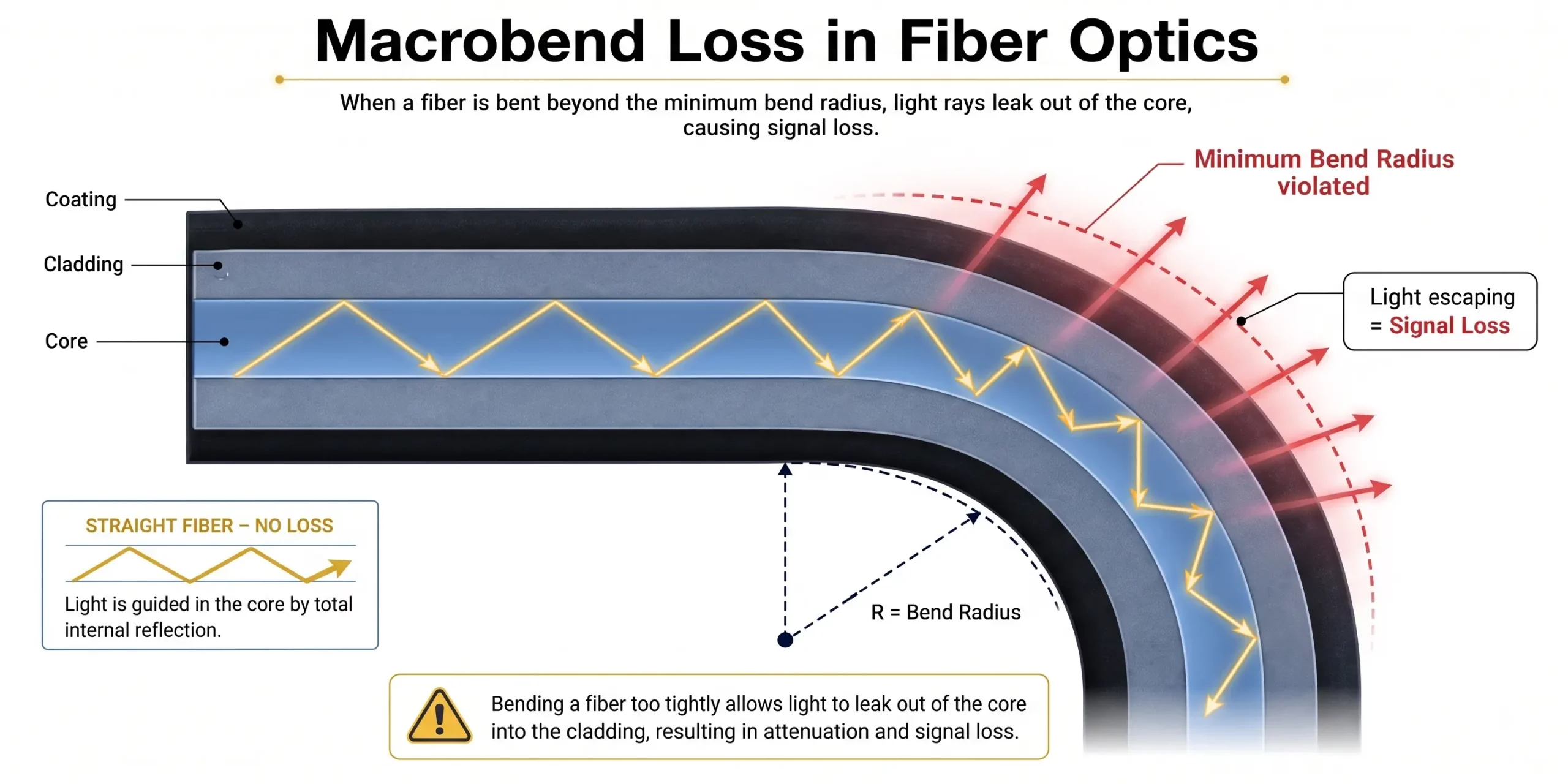
These are the visible, overly tight bends — a cable forced around a sharp rack edge, routed through a too-narrow conduit, or simply kinked during installation. Under normal conditions, light travels through the fiber core via total internal reflection, bouncing cleanly between the core and the cladding boundary. The moment the bend becomes too tight, the angle of incidence changes. Light can no longer reflect back into the core — it escapes into the cladding and is lost. The result is immediate, measurable signal attenuation.
Microbending
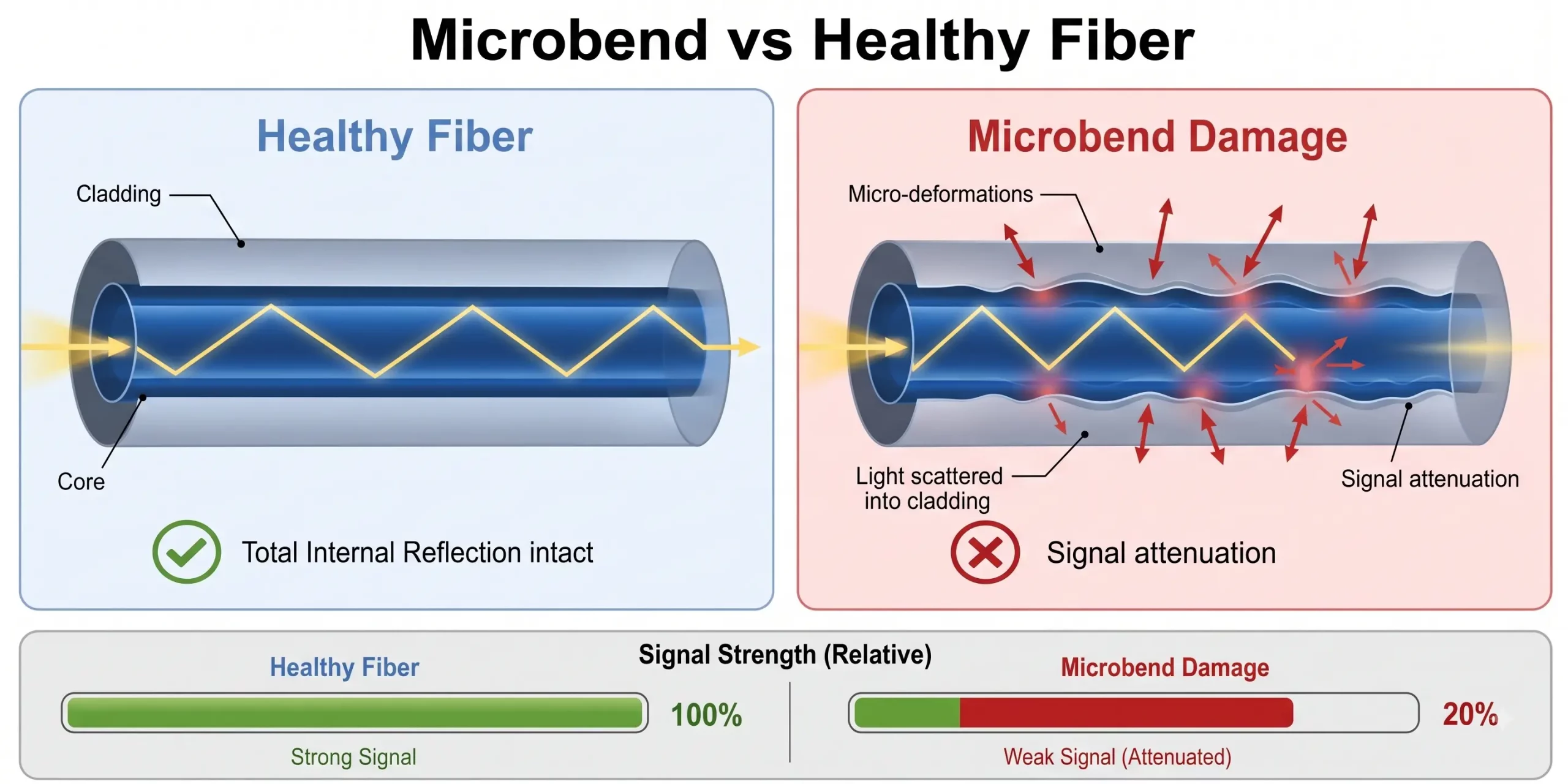
These are the silent killers: tiny, often invisible deformations of the core-cladding boundary caused by excessive pressure (over-tightened cable ties, staples, cable trays loaded beyond capacity) or extreme temperature fluctuations. Even though nothing looks wrong on the outside, light is scattered in all directions at each micro-deformation point, causing severe and cumulative signal loss — in extreme cases exceeding 100 dB/km.
The cascading impact on your Ethernet network:
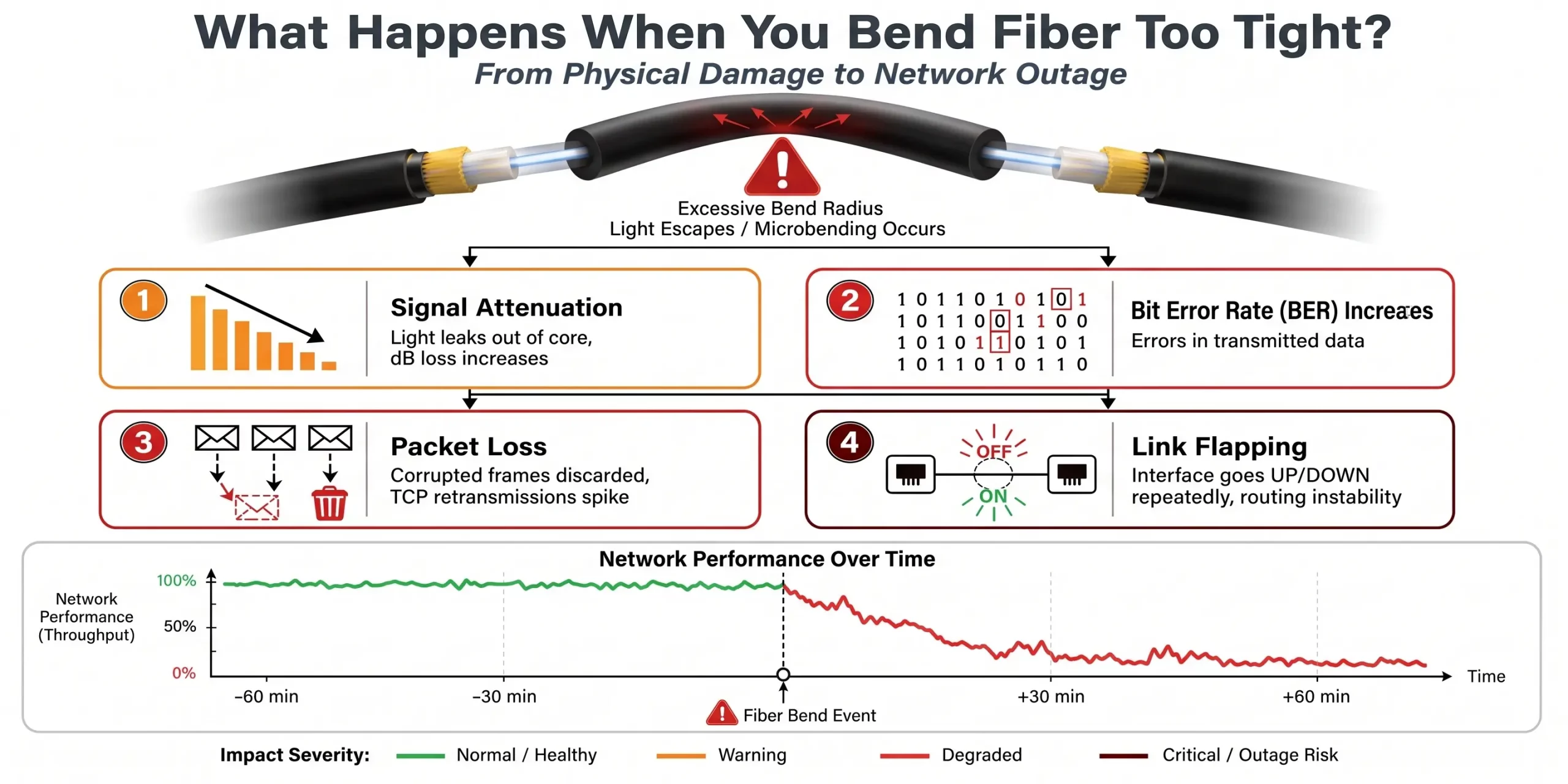
Once optical signal integrity is compromised, the effects propagate rapidly up the network stack:
- Signal Attenuation:
The optical power reaching the receiver drops below its sensitivity threshold. The transceiver or SFP module struggles to cleanly decode the incoming light signal. - Rising Bit Error Rate (BER):
Errors begin appearing in the transmitted bitstream. The receiving device can no longer distinguish a clean “1” from a “0” with confidence. - Packet Loss:
Corrupted Ethernet frames are discarded at the switch level. TCP detects the missing data and triggers retransmissions — consuming bandwidth, increasing latency, and degrading application performance. What looks like a “slow network” is often a bent fiber. - Link Flapping:
When the signal hovers right at the receiver’s sensitivity edge, the interface oscillates between UP and DOWN states. Every flap triggers Spanning Tree recalculations, routing protocol reconvergence (OSPF/BGP), and can cascade into broader network instability affecting entire segments or sites.
The practical rules — commit these to memory:
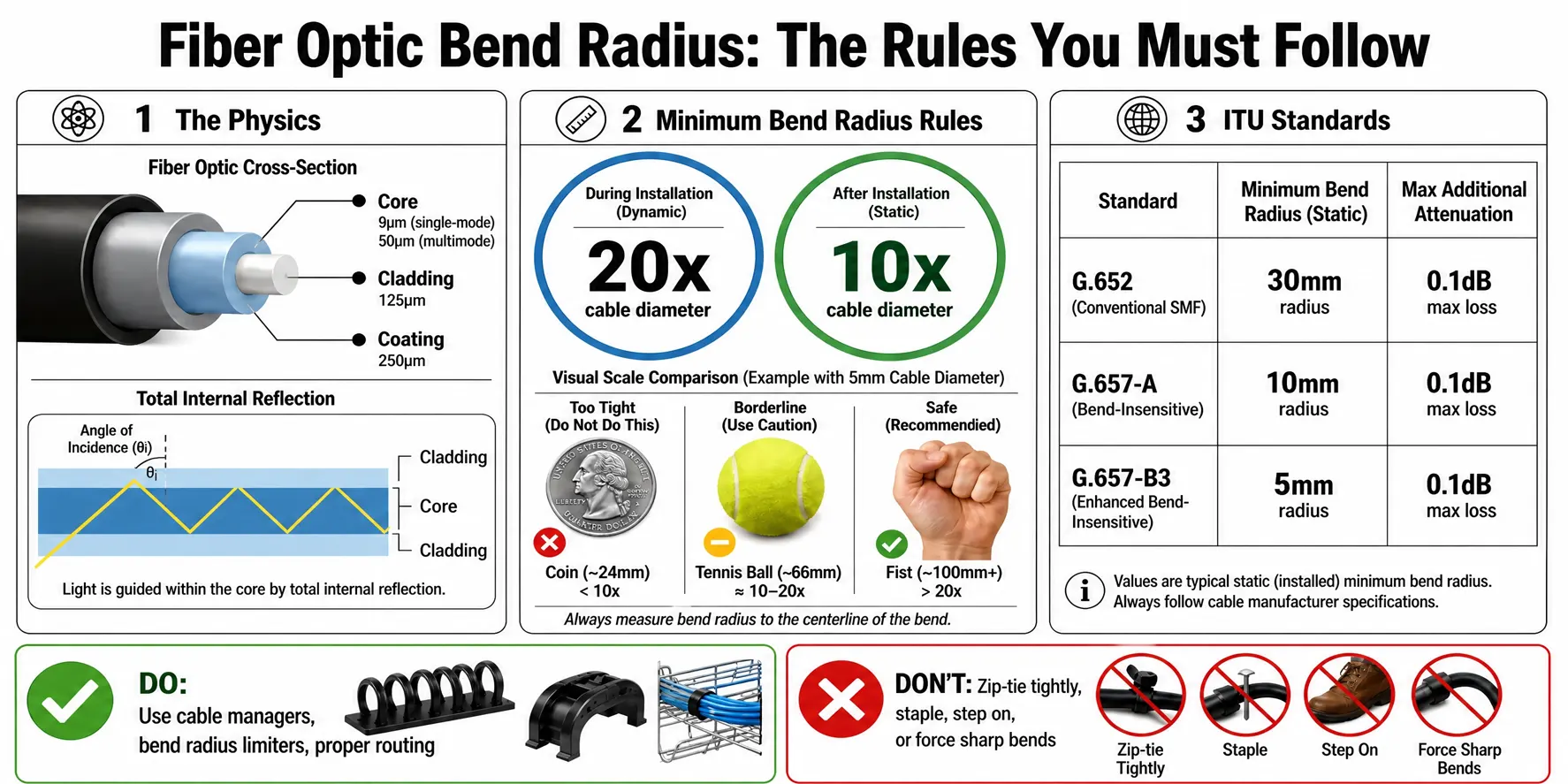
Phase | Minimum Bend Radius |
During installation (dynamic) | 20 × cable outer diameter |
After installation (static) | 10 × cable outer diameter |
For reference: a standard 5mm fiber cable must never be bent tighter than a 50mm radius once installed. That is roughly the size of a tennis ball.
ITU-T standards define it clearly:
- G.652 (conventional single-mode): 30 mm minimum static radius
- G.657-A (bend-insensitive): 10 mm minimum static radius
- G.657-B3 (enhanced bend-insensitive): 5 mm minimum static radius
Pro Tip:
Even bend-insensitive fibers (G.657) are not immune to damage — they simply tolerate tighter bends before losses become significant. Clean cable management, Velcro straps instead of rigid zip ties, proper bend radius limiters in patch panels, and post-installation OTDR testing are your best defence against unexplained network outages that trace back to a single kinked cable.

Timur is the Founder and CEO of NEOX, bringing over 25 years of expertise in network visibility and security to the company. His extensive experience has given him a profound insight into the challenges faced by today’s CXOs and IT teams. Timur is driven by a passion for harnessing technology to address complex issues, with a particular focus on leveraging network visibility as a strategic advantage. Prior to founding NEOX, he held various roles in sales and business development at several tech companies.