
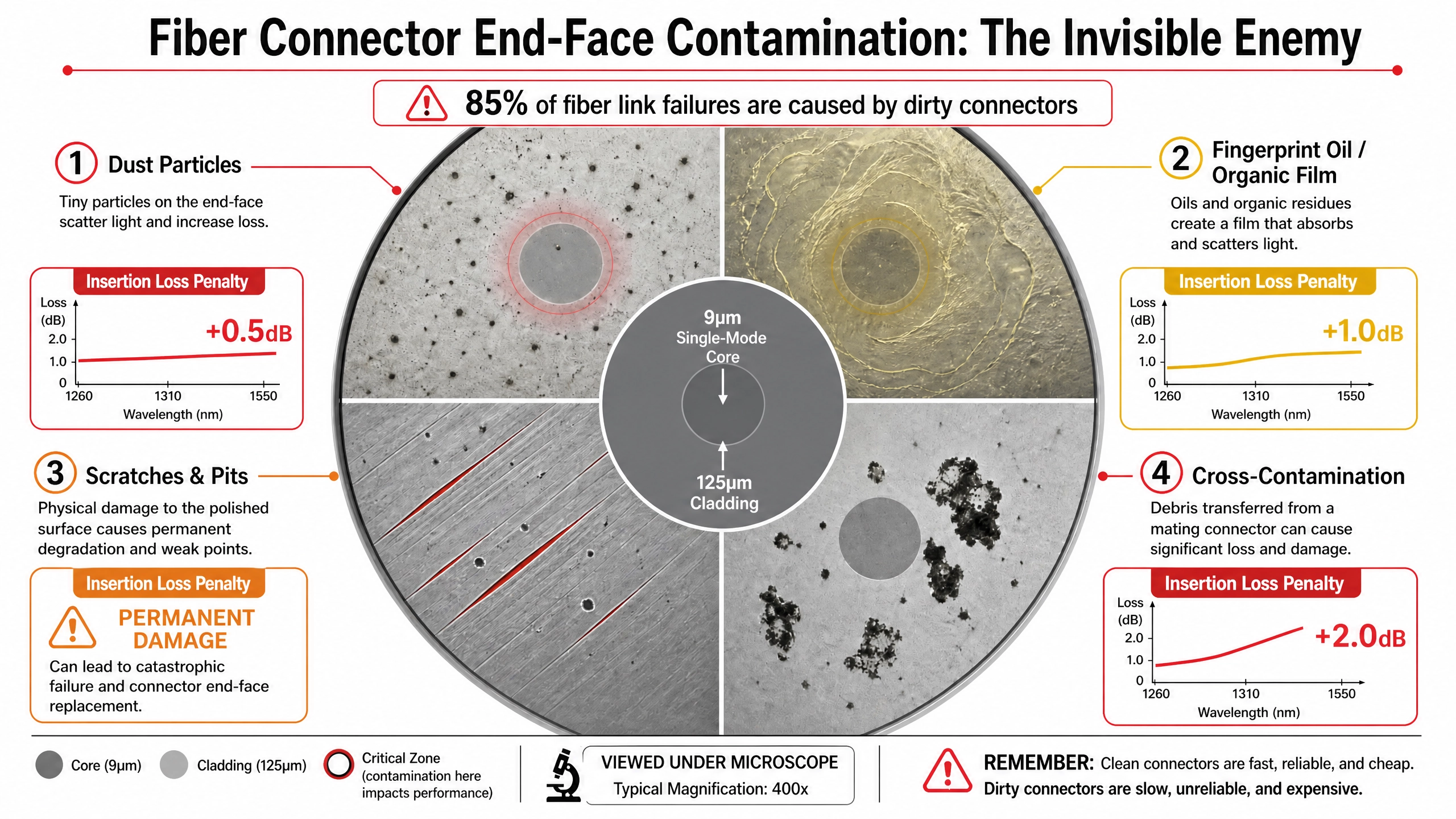
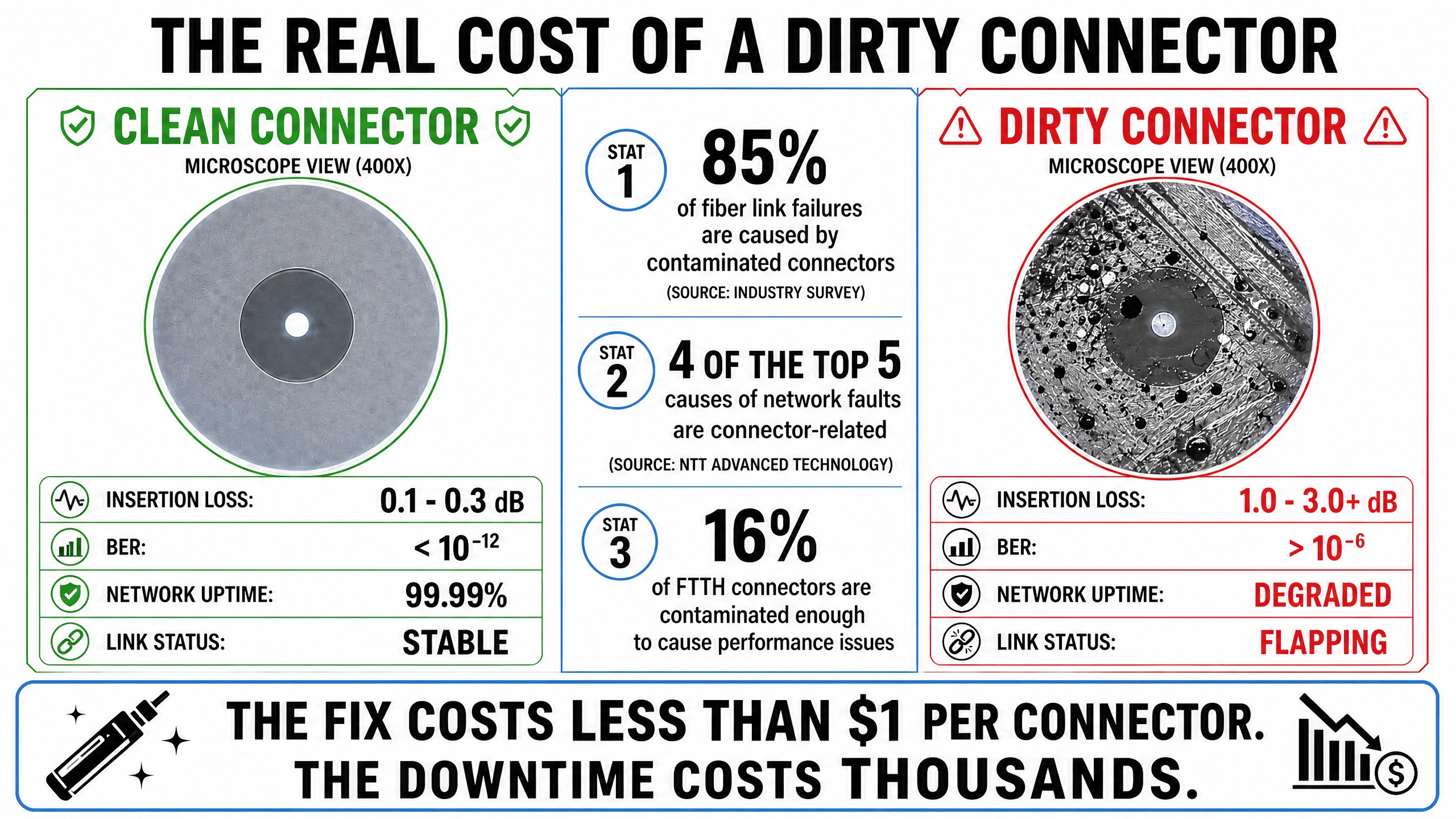
Did you know that 85% of fiber link failures are caused by one simple thing? Dirty connectors.
It is the most common — yet most preventable — cause of network degradation. A single-mode fiber core is just 9 micrometers wide. That is roughly one-tenth the width of a human hair. At that microscopic scale, a tiny speck of dust, a smudge of fingerprint oil, or residue from a “protective” dust cap acts like a boulder blocking a highway.
Here is what happens when you plug in a contaminated fiber connector:
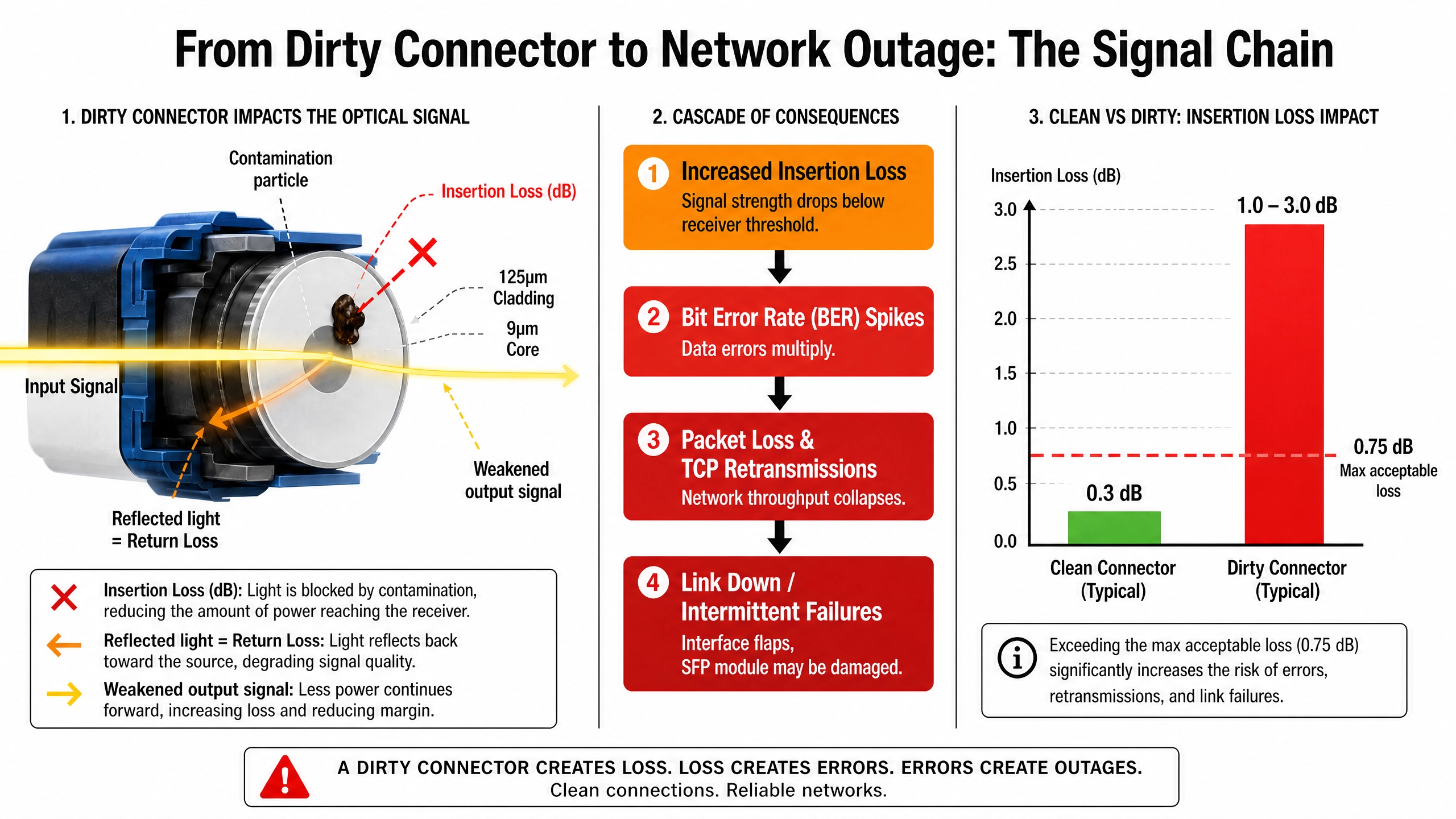
- Immediate Insertion Loss & Return Loss The contamination absorbs and scatters the light. The optical power reaching your receiver drops instantly (Insertion Loss), and light reflects back into the transmitter (Return Loss), degrading the signal-to-noise ratio.
- The Domino Effect on the Network Just like with fiber bending, a weak optical signal causes the Bit Error Rate (BER) to spike. Corrupted frames are dropped, TCP retransmissions consume your bandwidth, and eventually, the interface starts flapping UP and DOWN.
- Permanent Physical Damage This is the worst part: mating a dirty connector doesn’t just block light — it physically grinds the dirt into the glass ferrule. A microscopic piece of sand pressed between two connectors at high pressure will cause permanent pits and scratches. You just destroyed a perfectly good patch cord or, even worse, an expensive transceiver port.
The 3 Golden Rules of Fiber Maintenance:
Myth:“It has a dust cap on, so it’s clean.”
Fact: Dust caps protect against physical damage, not contamination. The plastic outgasses over time, and manufacturing mold-release agents often remain inside the cap. Always clean new patch cords.
Myth:“I can just wipe it on my shirt or blow on it.”
Fact: Your breath contains moisture and oils. Your shirt contains lint and static charge. You are making it worse.
Myth:“Dry wiping is enough.”
Fact: Dry wiping creates a static charge that acts like a magnet, pulling dust right back onto the end-face.
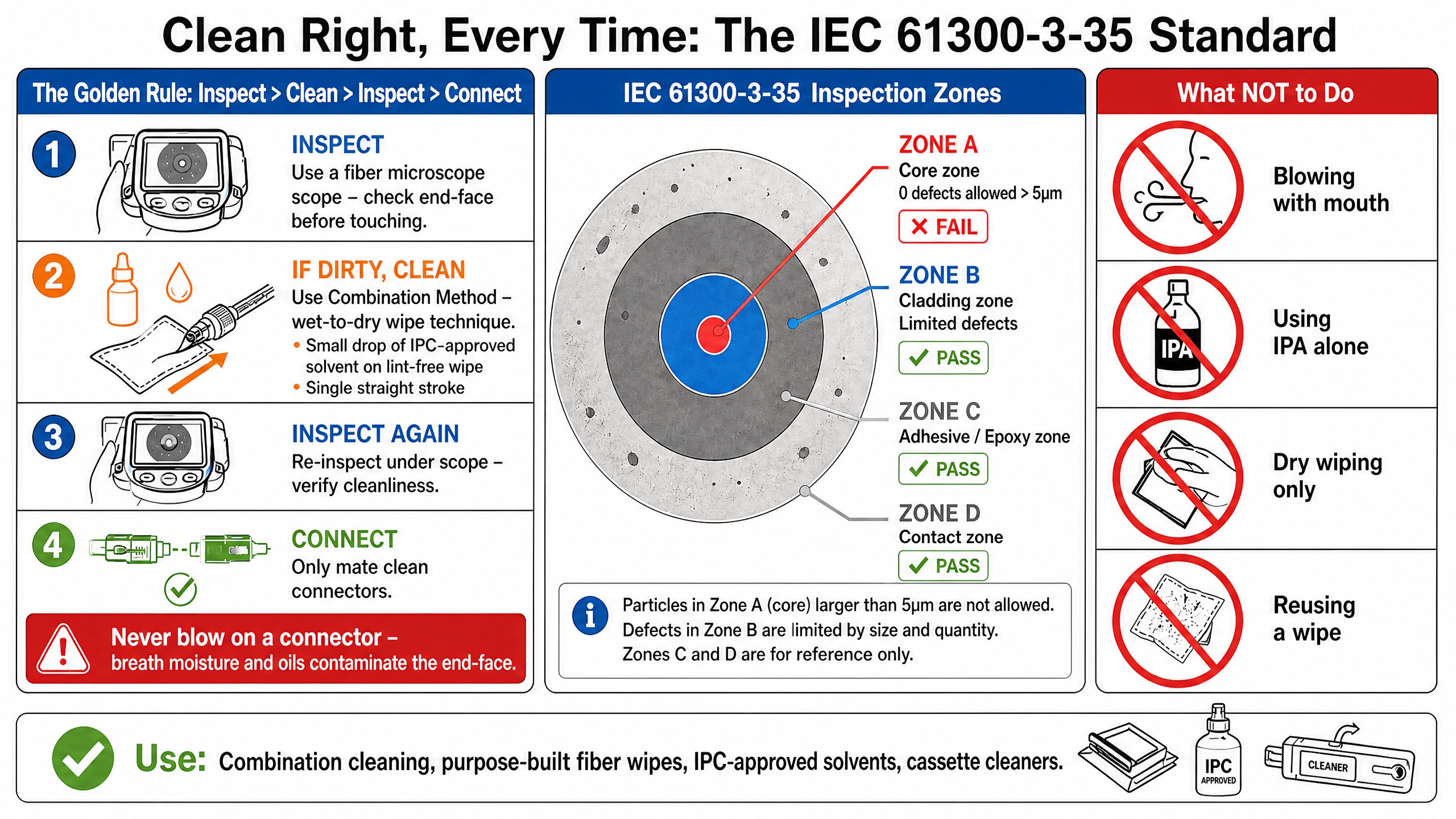
The IEC 61300-3-35 Standard Solution: The industry-standard best practice is the Combination Cleaning Method(Wet-to-Dry).
Use a lint-free wipe with a tiny drop of IPC-approved solvent. Swipe the connector from the wet spot to the dry area in a single, straight motion. The solvent breaks the static charge and dissolves oils; the dry wipe removes the debris.The ultimate mantra for any network engineer: 👉 Inspect > Clean > Inspect > Connect
Never mate a connector blindly. A proper cleaning tool costs less than $1 per click. A network outage costs thousands.

Timur is the Founder and CEO of NEOX, bringing over 25 years of expertise in network visibility and security to the company. His extensive experience has given him a profound insight into the challenges faced by today’s CXOs and IT teams. Timur is driven by a passion for harnessing technology to address complex issues, with a particular focus on leveraging network visibility as a strategic advantage. Prior to founding NEOX, he held various roles in sales and business development at several tech companies.