
The Ultimate Fiber Optic Cheat Sheet: Everything a Network Engineer needs to know in one place.
Whether you are designing a 100G data center backbone or troubleshooting a long-haul DWDM link, fiber optics comes down to mastering a few core physical principles. I have compiled the ultimate summary of the parameters that dictate whether your link stays UP or goes DOWN.
The Math: Optical Power Budgets
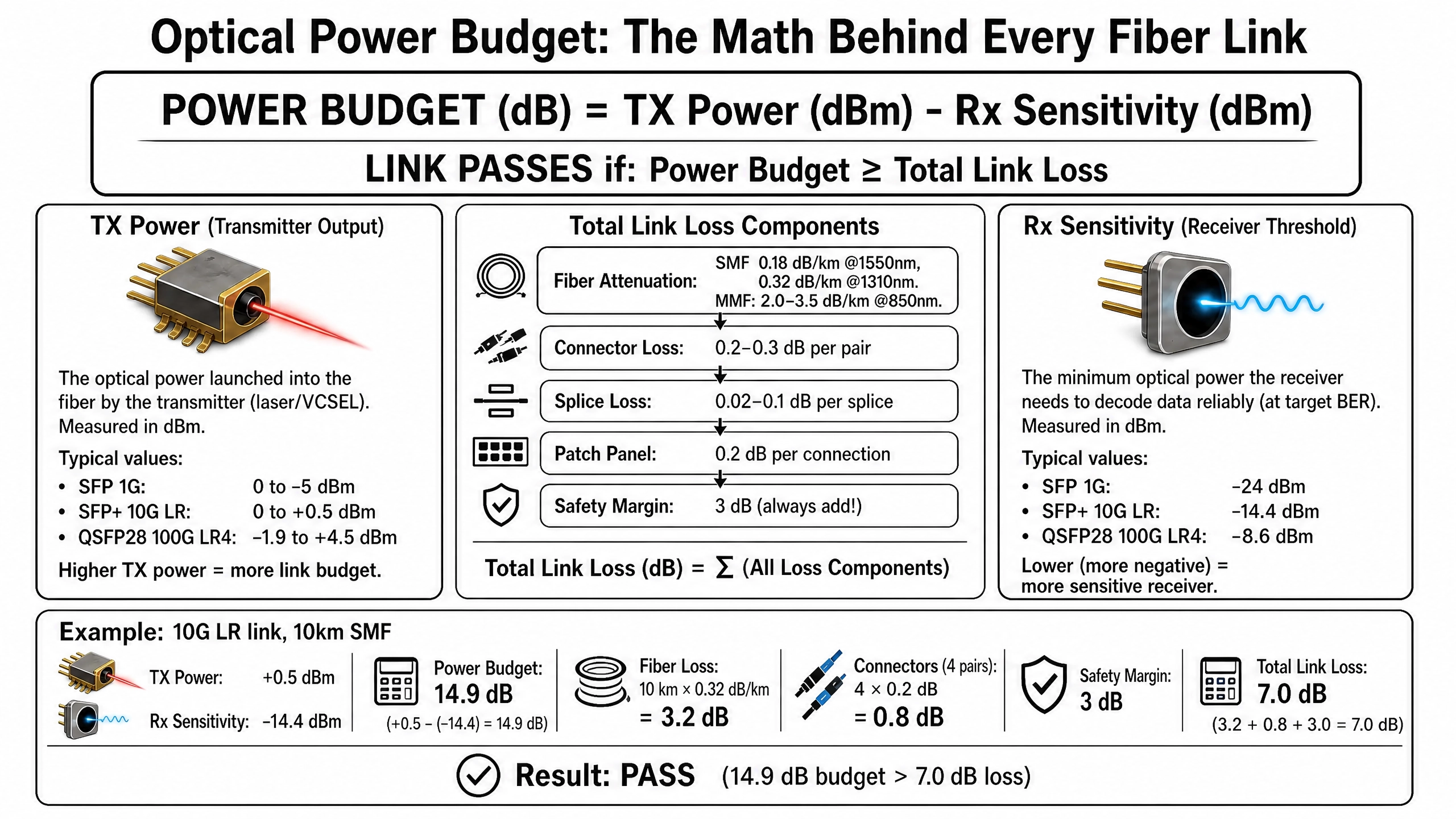
Will your link work? It all comes down to a simple formula: Power Budget = TX Power – Rx Sensitivity
- TX Power (Transmitter Output): The strength of the light leaving your SFP/QSFP module. Higher is better for long links.
- Rx Sensitivity: The minimum light level the receiver needs to decode data reliably. Lower (more negative) means a more sensitive receiver.
- The Rule: Your Power Budget must be greater than your Total Link Loss (Fiber attenuation + Connector loss + Splices + a 3dB safety margin). If loss exceeds the budget, the link fails.
The Losses: Insertion vs. Return Loss
Every connection introduces two types of loss:
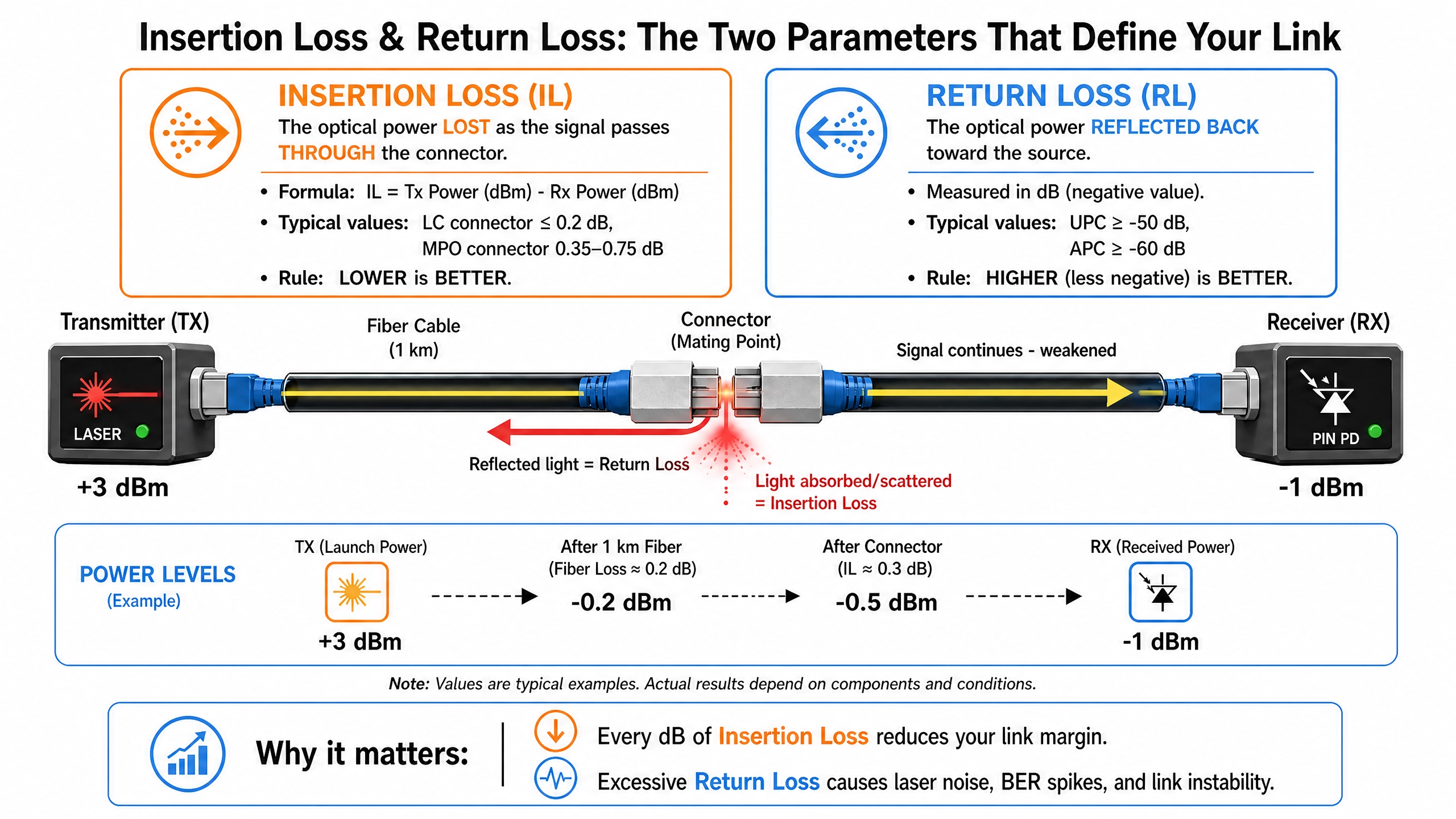
- Insertion Loss (IL): The light that is absorbed, scattered, or blocked as it passes through a connector. Lower is better (Target: ≤ 0.2 dB for LC, ≤ 0.35 dB for MPO).
- Return Loss (RL): The light that reflects back toward the laser source. High reflections cause laser noise and BER spikes. Higher (less negative) is better (Target: -50 dB for UPC, -60 dB for APC).
The Connectors: LC vs. MTP/MPO
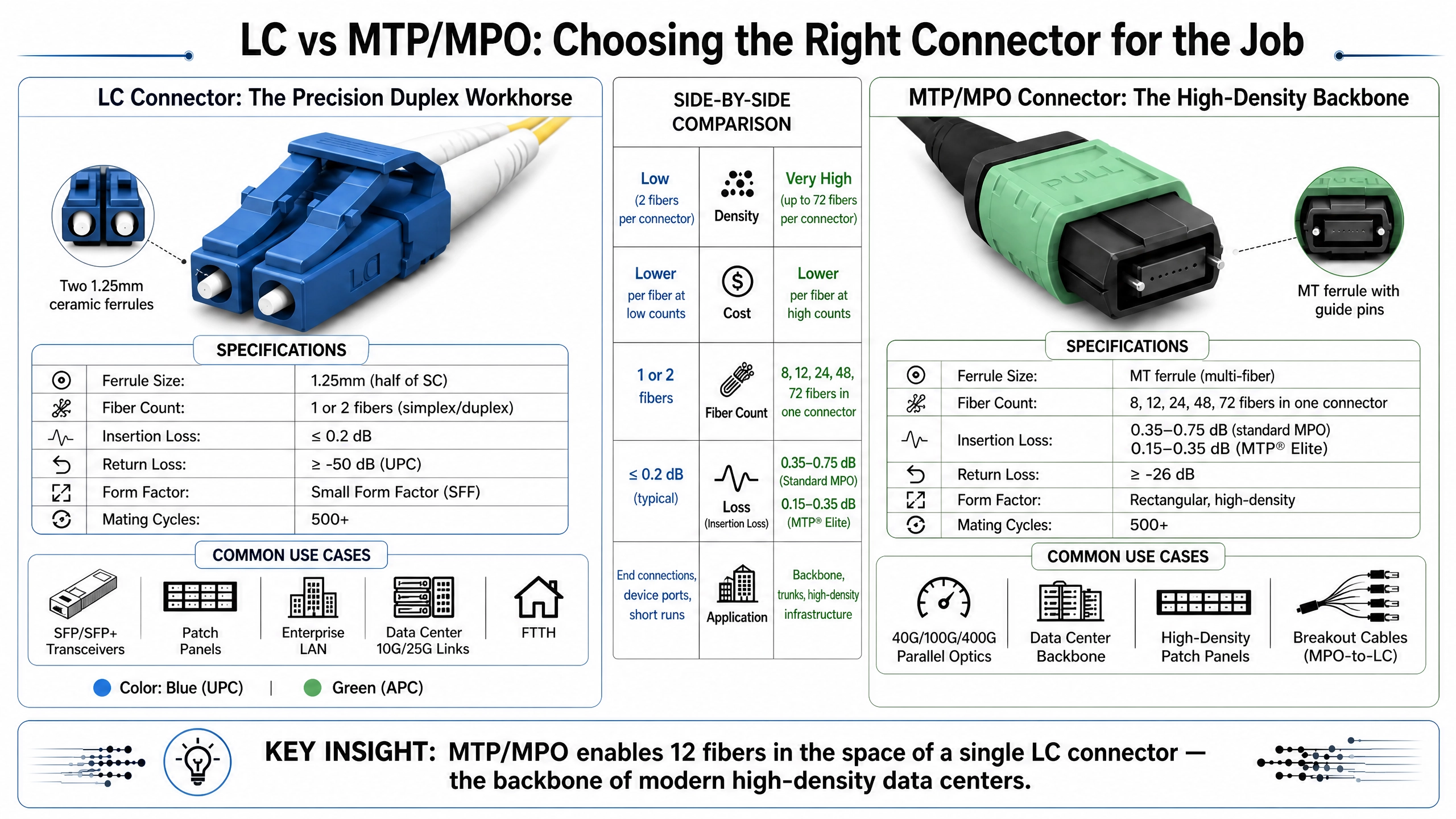
- LC (Lucent Connector): The precision workhorse. Uses a tiny 1.25mm ceramic ferrule. Perfect for standard 10G/25G duplex links patching into servers and switches.
- MTP/MPO: The high-density backbone. Packs 8, 12, 24, or even 72 fibers into a single rectangular connector. Essential for 40G/100G/400G parallel optics and spine-and-leaf data center architectures.
The Speed Killer: Dispersion
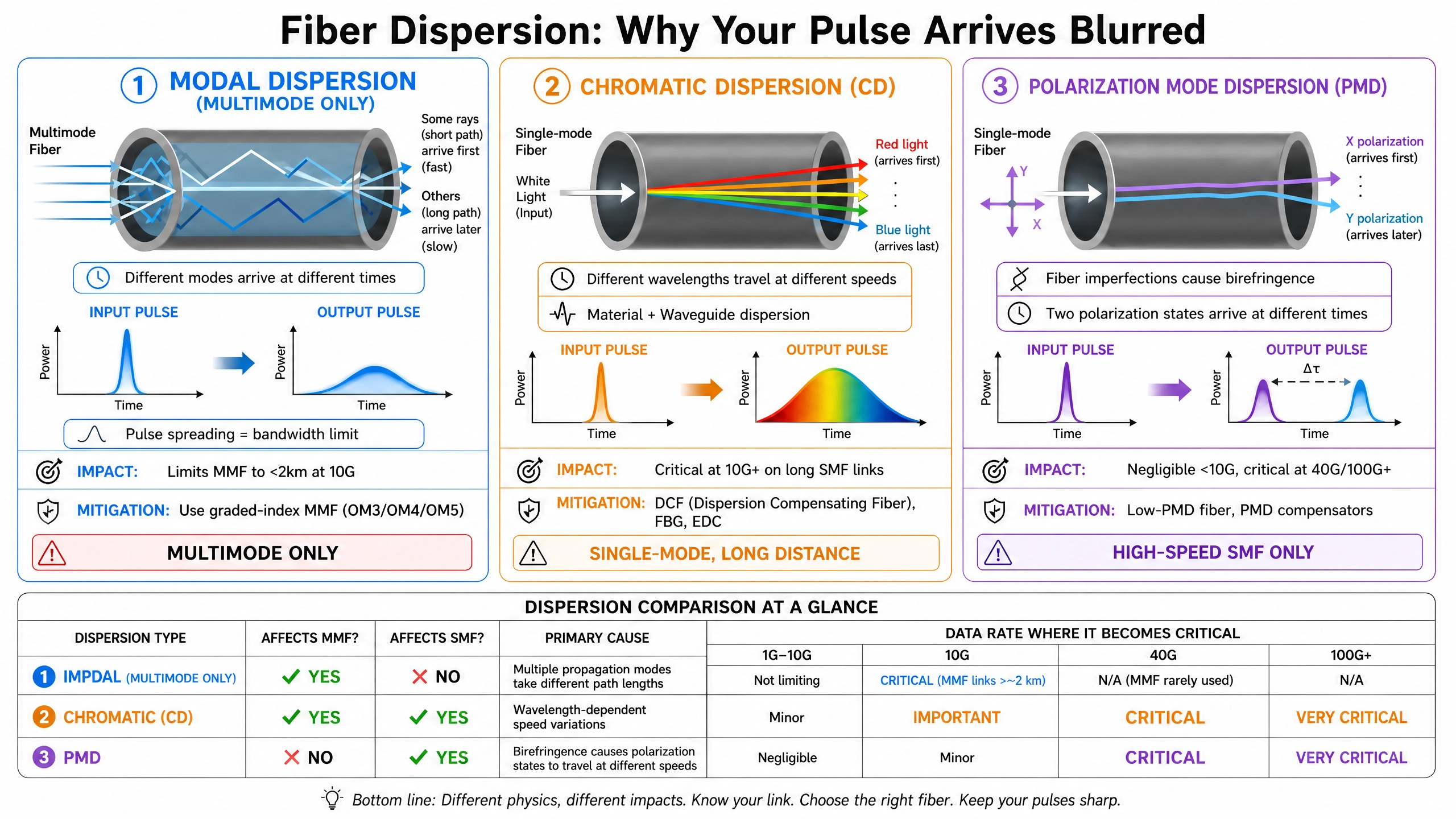
Why does a signal blur over distance? Dispersion.
- Modal Dispersion: Happens only in Multimode fiber. Different light rays take different paths (some straight, some zigzagging), arriving at different times. This limits MMF to <2km at 10G.
- Chromatic Dispersion (CD): Happens in Single-mode fiber. Different colors (wavelengths) of light travel at slightly different speeds. Red arrives before blue. Critical to manage on long-haul 10G+ links.
- Polarization Mode Dispersion (PMD): Fiber imperfections cause different polarization states to travel at different speeds. The final boss of 40G/100G+ long-haul networks.
The Distance: How Far Can You Go?
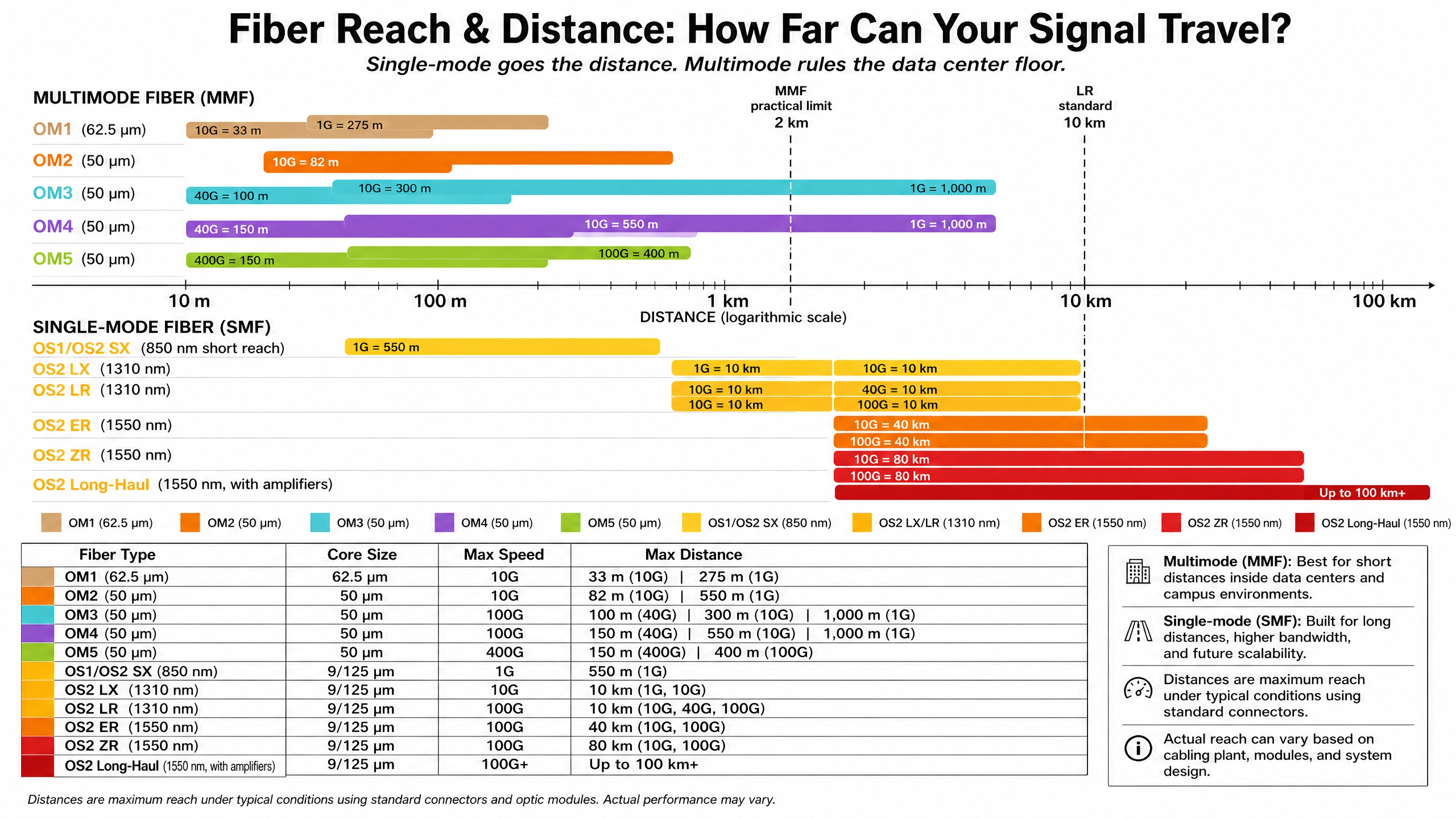
- Multimode (OM3/OM4/OM5): Rules the data center floor. Great for high-speed, short-reach links (up to 100m–150m for 40G/100G).
- Single-mode (OS2): Goes the distance. Standard LR optics push 10km. ER optics hit 40km. ZR optics reach 80km. With amplifiers and dispersion compensation, it spans oceans.

Timur is the Founder and CEO of NEOX, bringing over 25 years of expertise in network visibility and security to the company. His extensive experience has given him a profound insight into the challenges faced by today’s CXOs and IT teams. Timur is driven by a passion for harnessing technology to address complex issues, with a particular focus on leveraging network visibility as a strategic advantage. Prior to founding NEOX, he held various roles in sales and business development at several tech companies.